Growing Onions in a Cool Climate: What a Local Farmer Taught Me
Growing onions shouldn’t be difficult.
They’re one of those vegetables that quietly appear in almost every meal. Soups. Curries. Roasts. Salads. Even eaten raw if you’re brave enough. Yet despite being such a staple crop, they can be surprisingly frustrating to grow well, especially in a cool climate.
Last year our onions were… underwhelming.
They grew, but only just. Instead of nice big bulbs, we ended up with lots of little onions that were perfectly edible but nowhere near what we were hoping for. It wasn’t the harvest we’d imagined.
This year, we’re trying something different.
Sometimes the best gardening advice comes from people who have been doing it for decades
A few weeks ago we were chatting with one of the local organic growers at our farmers market.
Naturally, I asked the question every gardener asks when they see someone else’s incredible produce:
“How do you grow your onions so big?”
His answer was wonderfully simple.
“Plant them on the winter solstice.”
Now whether that’s decades of observation, perfect timing with the seasons, or just a little gardening folklore, I honestly don’t know. But when someone who consistently grows beautiful onions offers advice, I’m inclined to listen.
So this year we’re giving it a go.
Technically we planted them one day after the winter solstice. Hopefully the gardening gods are forgiving.
Not all onions are created equal
One thing I’ve been learning is that onion varieties matter much more than I realised.
For our region, the recommendation was to grow long-day onions, particularly Cream Gold.
Until recently I’d never really thought about day length requirements. I’d simply bought onion seeds and expected them to grow.
But onions use day length as the signal to start forming bulbs. Plant the wrong variety in the wrong climate and you’ll often end up with lots of leaves but very little onion.
We’re trialling three different varieties this season:
- Cream Gold
- Sweet Red
- Gladalan Brown
The Gladalan Browns are particularly interesting because they’re being grown as onion sets rather than seedlings.
Onion sets versus seedlings
This is my first year growing onion sets.
Unlike tiny seedlings, onion sets are small immature bulbs that have already had a head start. The theory is they establish faster, cope with cold weather better and often mature earlier.
They’re a little more expensive than seedlings, but if they produce larger onions they’ll probably be worth every cent.
That’s part of the fun of gardening.
Every season becomes an experiment.
Even experienced gardeners have failures
One thing that surprised me this year was the Cream Gold seed. None of mine germinated. I tried multiple times using different methods. Nothing. Then I discovered our local community garden had exactly the same problem.
Sometimes gardening isn’t your fault, sometimes seed batches simply aren’t viable.
It’s a good reminder that even experienced gardeners occasionally lose battles before the plants ever make it into the ground.
Rather than giving up, I simply bought healthy seedlings from our local nursery and carried on. Gardening rewards persistence.
Choosing the right place
Onions aren’t particularly demanding, but they do appreciate consistency.
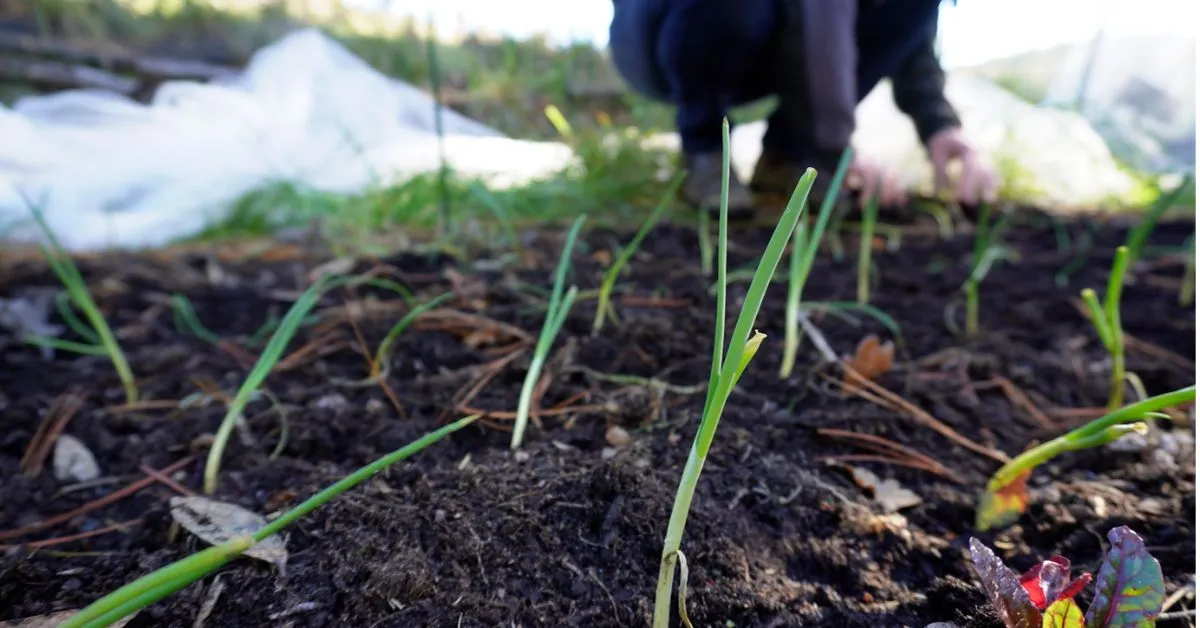
This year we’ve planted ours in one of our best-performing beds.
It receives plenty of sunlight, has reliable access to water and, after months of improving the soil with compost and organic matter, it’s become beautifully friable.
Good soil makes everything easier. Healthy roots almost always produce healthier plants.
Why bother growing onions?
It’s a fair question.
You can usually buy onions cheaply from the supermarket. But that’s not really why we grow them. We grow onions because every season teaches us something. We grow onions because learning how food is produced changes the way you think about every meal. We grow onions because food security matters. And perhaps most importantly, we grow onions because one day those cheap supermarket vegetables might not be so cheap anymore. Knowing how to grow your own food isn’t just a hobby. It’s a life skill.
Looking ahead
Now comes the hardest part – waiting.
Onions aren’t a crop that rewards impatience. They’ll happily sit in the garden for months while you wonder whether anything is actually happening.
We’ll keep them watered, protect them from hungry critters and let nature do its thing.
By summer we’ll find out whether the local farmer’s advice was right, whether onion sets outperform seedlings, and which variety earns a permanent place in our garden.
That’s one of the things I love most about gardening.
Every season starts with optimism and every harvest ends with lessons.
And every year, hopefully, you grow a little wiser alongside your vegetables.